Choosing the right wastegate for your build
Wastegates don't get much attention. Most conversations revolve around turbo size, boost pressure or horsepower targets. Fair enough. They're usually the exciting parts of a build. The wastegate often ends up somewhere further down the shopping list. That's a mistake.
We've seen plenty of turbocharged engines where the turbocharger itself was perfectly matched to the application, and yet the wastegate became the limiting factor. On the dyno, everything looked fine, on track however, things started behaving differently. Boost control became inconsistent, temperatures climbed, and drivers lost confidence in the car.
A wastegate isn't just there to stop an engine from overboosting. It plays a major role in how a turbocharged engine responds, performs and behaves under load. Making sure you choose the right one saves a lot of hassle down the line.
What Does a Wastegate Actually Do?
In simple terms, a wastegate controls how much exhaust gas reaches the turbine.
The more exhaust gas flows through the turbine, the faster the turbocharger spins, and the more boost it creates. At some point, that boost level needs to be controlled.
The wastegate opens, diverting a portion of the exhaust flow away from the turbocharger. That keeps boost pressure where it should be rather than allowing it to continue climbing. This sounds simple, but in reality, wastegate sizing and placement has a big impact on how effectively this happens.
Internal or External Wastegates?
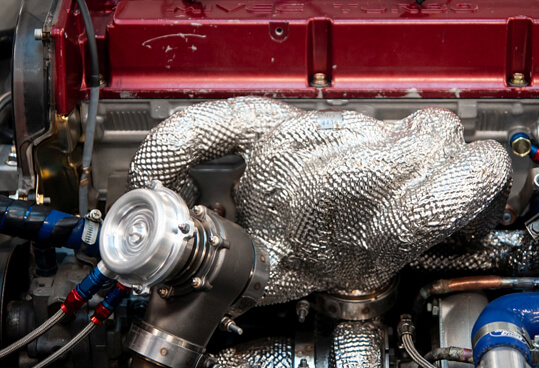
For many road cars, an internal wastegate works perfectly well. It's compact, cost-effective and keeps everything neatly packaged. However, once you move into serious performance applications, things start to change.
Larger turbochargers move significantly more air. Engine outputs increase. Exhaust flow rises. The demands on the boost control system increase, which is why external wastegates are so common in motorsport.
The advantages:
- Improved boost control
- Better flow capacity
- Reduced risk of boost creep
- Easier spring changes
- Greater consistency under extreme conditions
When you’re dealing with very high power, an external wastegate is often the better long-term solution.
Choosing the Right Wastegate
There isn't a magic answer to choosing the ‘right’ wastegate. A wastegate that works brilliantly on one engine may be completely unsuitable for another, and so, therefore, a few key factors need to be considered.
Engine Capacity
A 1.6-litre turbocharged engine and a 3.5-litre turbocharged engine produce very different exhaust flow levels. As engine size increases, the wastegate generally needs to manage greater volumes of exhaust gas.
This becomes especially important when targeting lower boost pressures on larger engines, where substantial exhaust flow needs to be diverted away from the turbine.
Turbocharger Size
Turbo size matters as much. Large-frame motorsport turbochargers typically require more wastegate flow than smaller road-car units. We've occasionally seen situations where builders focus heavily on selecting the perfect turbocharger but underestimate the wastegate requirements.
As a result you can get unstable boost control at higher RPM, particularly under sustained load.
Target Boost Pressure
Boost targets play a part too. Cars running moderate boost levels often place different demands on the system compared with high-boost drag or time attack applications.
The spring combination, control strategy and wastegate sizing all need to work together.
Packaging Constraints
This is where theory often meets reality, because not every engine bay provides unlimited space. Exhaust routing, manifold design, suspension components and heat management all influence what can realistically be installed.
Sometimes the perfect solution on paper won't fit.
Different Motorsport Disciplines, Different Requirements
Drift
Throttle response and predictable boost delivery are key. Drivers constantly move between throttle positions while controlling wheel speed and vehicle angle. A consistent boost behaviour does make a noticeable difference.
Time Attack
Time attack cars spend long periods operating under significant load. With this in mind, boosting stability becomes critical, and any inconsistency can affect both lap times and reliability.
Drag Racing
In drag racing, wastegates need to handle extremely high exhaust flow rates and aggressive boost control strategies. Being able to do this repeatedly really matters.
Rallycross
Rallycross combines rapid throttle transitions, varying surfaces and harsh operating conditions. Response matters, and reliability matters as much.
Experience Still Matters in high-level scenarios.
Wastegates aren't particularly complicated components, but choosing the correct one often is. Since the 1980s, DSPS has been supplying advanced turbocharging and boost control solutions to some of the world's most demanding motorsport environments. We have worked alongside leading organisations competing at the highest levels of rallying, circuit racing and Formula One.
Our team consists of engineers and motorsport enthusiasts who genuinely enjoy what they do. That practical experience allows us to look beyond specifications on a product sheet and recommend solutions based on real-world applications. Because every build is different and getting it right the first time is usually far cheaper than discovering the limitations later.
Final Thoughts
There's no single wastegate that suits every application. Engine size, turbocharger specification, target boost levels and vehicle use all play a role in determining the correct choice. It is worth taking the time to get it right - Your turbocharger, tuner and engine will thank you for it.
If you're planning a new build and need advice on wastegate selection, the DSPS team can help identify the most suitable solution for your application.