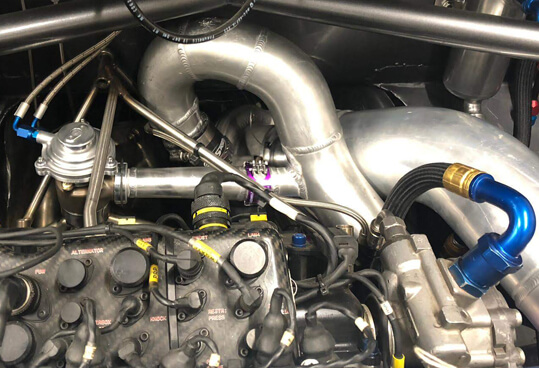
Anti-lag is now an integral technology in modern performance tuning. If you’ve ever heard the rapid-fire pops and bangs from a rally car, well, that’s anti-lag at work. The system is designed to keep a turbocharger spinning, even when the driver lifts off the throttle, ensuring instant boost when they get back on the power In the world of motorsport, where response time can make or break a stage, anti-lag remains a vital tool for drivers chasing every possible advantage.
DSPS are one of the most well-known brands in engineering, specifically motorsport. We take pride in our contributions to multiple championship wins in IndyCar, WRC, Indy Lights, RallyX, Le Mans, WEC, GT Racing, DTM, SGT, WTCC, Dakar, and F1. Our rich 40-year history allows us to offer the best expertise and advice regarding anti-lag valves in motorsport.
What Are Anti-Lag Valves?
Anti-lag valves (ALVs) help keep a turbocharger spinning even when you lift off the gas. They make sure the turbo doesn’t just sit idle by continuing airflow and pressure, even when the throttle is closed. This makes them different from older anti-lag systems, such as ignition-retard or combustion-based strategies, as these relied on explosive burn events or raw airflow dumps to keep the turbo alive. Those traditional methods produced high heat, loud bangs, and significant mechanical stress.
ALVs, offer a smoother, more mechanical approach by modulating air precisely. All without relying on aggressive ignition timing or constant exhaust combustion. Their primary function is to maintain turbo speed safely and consistently.
Modern motorsport teams prefer ALVs, because they integrate cleanly with ECU-controlled boost strategies and also reduce wear on engine components. Depending on the vehicle and racing class, ALVs can be pneumatic or electronically actuated.
The Role of Anti-Lag Valves in Motorsport
Anti-lag valves play a crucial role in competitive motorsport. They help keep the turbo boost steady during throttle lifts, gear shifts, or quick off-throttle moments. By preventing the turbo from spooling down, ALVs ensure the engine stays in its power zone, especially during gear changes, reducing the usual drop in turbo speed between shifts. This is also very helpful when braking into corners. With immediate turbo response, drivers can quickly regain power, allowing for more aggressive and controlled corner entry and exit. In tight rally stages, autocross layouts, and technical circuits, ALVs prevent hesitation and preserve momentum through slower or more complex sections. They also create a more linear and predictable throttle feel, giving drivers the confidence to reapply power without delay.
Integrated with paddle-shift or flat-shift systems, they enable seamless transitions without loss of boost. Their consistency from lap to lap reduces the driver’s compensation workload and directly improves lap-time repeatability.
Why Milliseconds Matter in Rally and Time Attack
Anti-lag systems are crucial in disciplines where every millisecond matters.
In rallying, drivers constantly modulate throttle over unpredictable surfaces, jumps, and tight corners. Instant turbo recovery is essential, and ALVs deliver immediate torque at lift-off, keeping the car balanced and responsive.
Time Attack places similar demands on response, though in a slightly different way. Every lap is a flat-out attempt to extract the maximum possible speed from the car. Waiting even a brief moment for the boost to return can cost valuable time. With an ALV system in place, power is available as soon as the throttle is reapplied, allowing drivers to carry speed out of corners and stay on pace throughout the lap.
Track layouts and rally stages are often tight and technical, which makes strong low-end response even more valuable. A consistent boost gives drivers confidence as they approach braking zones or transition through corners. They can get back on the throttle at the apex.
Benefits Beyond Performance
The advantages of anti-lag valves go further than raw performance. A smoother driving experience is one of the more noticeable improvements. Throttle transitions become more predictable, which helps drivers keep the car balanced during delicate manoeuvres.
Less throttle correction also reduces fatigue. The matters over long rally stages or extended track sessions. When drivers aren’t constantly fighting delayed boost response, they can concentrate more on other things, such as braking points, racing lines, and situational awareness.
Reliability can also improve when the system is properly designed. ALVs reduce the need for aggressive, ignition-based anti-lag strategies, which are known to produce extreme exhaust temperatures. Lower heat levels mean less strain on surrounding components, including the turbocharger itself.
Another practical advantage lies in tuning and integration. Modern ECU systems can manage ALVs relatively easily. Thus, making them simpler for teams to monitor and adjust. Because the system maintains boost pressure without relying on combustion-based anti-lag methods, turbo wear can be reduced, and service intervals extended.
Taken together, these factors make ALVs a practical solution in many motorsport setups—offering a balance of performance, control, and mechanical protection.
Drawbacks and Considerations
Despite the advantages, anti-lag valves aren’t without compromises. Continuous operation places additional stress on the other parts of the vehicle, such as the turbocharger, exhaust components, and engine internals. Over time, that extra load can accelerate wear, particularly during long sessions where temperatures remain high.
For road cars, this kind of setup is rarely practical. Maintaining boost pressure continuously increases fuel consumption and heat levels, and some configurations may even exceed road-legal limits under local regulations.
Motorsport rules can also restrict the use of anti-lag systems. Certain racing classes impose limits on boost control strategies. This requires teams to configure ALVs so they remain compliant at all times.
Integration is another factor. The systems depend on accurate tuning and compatibility. When something isn’t configured in the right way, the results can range from inefficient boost control to unstable air-fuel ratios. In some cases, poor calibration can even reduce low-end performance, rather than improve it.
Because of this, teams often balance the performance benefits against long-term reliability. In endurance racing, especially, excessive heat cycles and component wear can become serious concerns. A well-engineered setup aims to deliver the benefits of anti-lag while keeping the engine and turbo system healthy throughout a race season.
Anti-lag valves exist for one primary purpose - to keep the turbocharger spinning. In motorsport, it transforms throttle response and offers a competitive advantage that no naturally aspirated setup can match. While not suitable for everyday driving, it remains one of the most influential technologies in performance high-level racing.
Having worked on championship-winning teams, it would undoubtedly be advantageous for those looking to gain a competitive edge to get in touch with our specialist team to see how we can work with you to create more efficient output via anti-lag technology. Our knowledge and motorsport expertise may give you the extra pace you need. We offer a range of anti-lag valves, from single-port to 3-lug. Please get in touch with us to explore how we can assist you today.